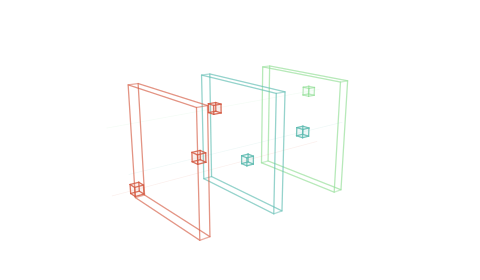
Separate responsibilities
Give implementation and verification different tool access. A checking stage can report a failure for rework without changing the code it is assessing.

We’re developing Anvil to organise AI-assisted coding from an agreed plan through implementation, review, and validation. Defined stages and saved evidence make the work easier to inspect and repeat.
Engineering teams already have conventions, checks, and review practices. Anvil makes them part of a reusable process instead of instructions to repeat in every conversation.
Each stage has its own guidance, tools, model, and expected result. A task can move through implementation, focused tests, and visual review, with a sequence tailored to the project.
Assign a model and reasoning level to each stage. Understanding an unfamiliar subsystem may need more reasoning than checking a small change; a separate review stage can question the implementation.
Each stage receives focused guidance, user decisions, and summaries of earlier work. Recorded token usage helps teams weigh model effort against the quality of the resulting changes.
Give implementation and verification different tool access. A checking stage can report a failure for rework without changing the code it is assessing.
Keep command output, results, and screenshots with the task. Inspect what ran, what it found, and what remains untested.
Pause and return to a task with its decisions and earlier attempts intact.
A passing test can become outdated after another edit. Anvil records workspace state when a stage finishes and flags earlier evidence as stale when a later check detects a change.
Saved reports and screenshots remain available across attempts. Reviewers can see what needs to run again and where coverage is still missing.
Anvil is a desktop prototype with configurable workflows, model choices, command approvals, separate task workspaces, and persistent history. Every completed stage pauses for human review and explicit continuation.
It works in local repositories and connects to cloud models. Tools are configured per stage; commands follow an approval policy. Stronger execution isolation remains planned work.
We want a stage to request narrowly defined help when needed: hand a check to another model, receive its result, and continue. The team would define the assignment, tools, and expected output in advance.
These bounded handoffs and stronger isolation are planned steps toward greater autonomy. Our aim is less time directing each exchange, with clear evidence and human judgment where it matters.
Tell us where AI-assisted development still takes too much coordination.